

By Clifford Ejenavi
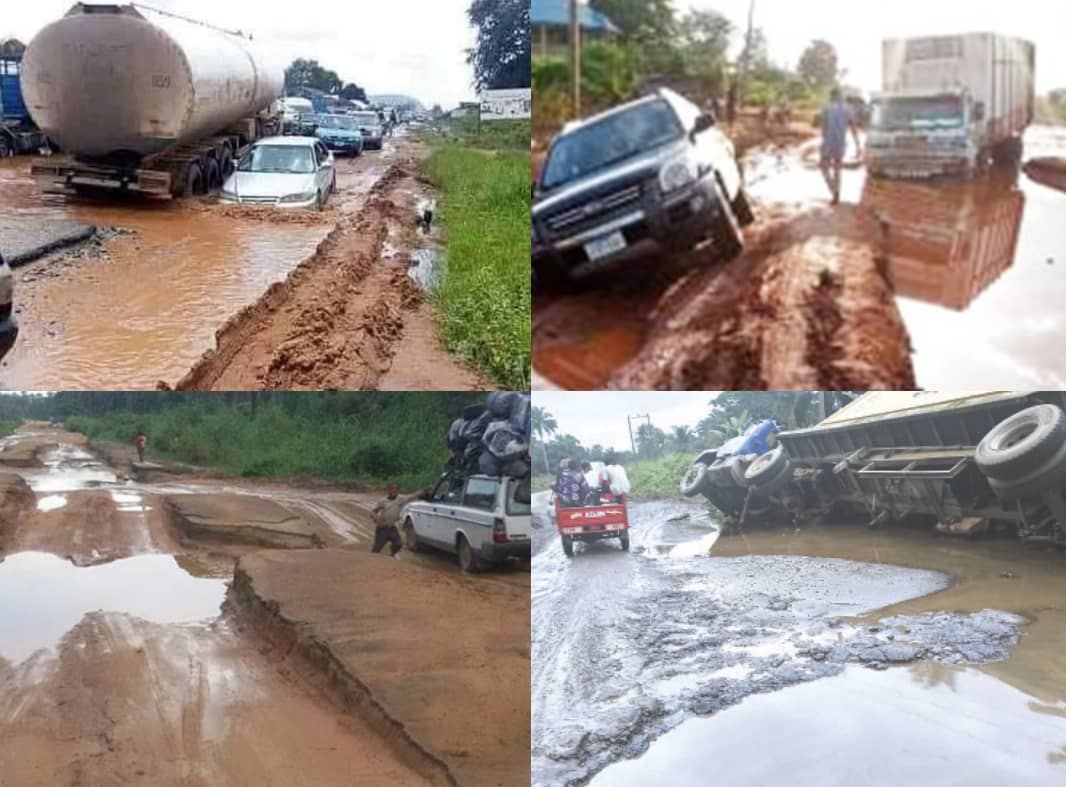
Across the South-South and South-East regions of Nigeria, what should have been smooth economic arteries have become nightmares of potholes, gullies and impassable stretches. From the busy Warri – Port Harcourt Highway to the Enugu – Onitsha Expressway and the Benin – Auchi – Okene Road, the story is the same, motorists and residents lamenting years of neglect and unfulfilled government promises.
A Journey Through Pain
For travellers plying the Benin – Sapele – Warri Road, the experience is often harrowing. What was once a major link between Edo and Delta States has deteriorated into a death trap. Drivers navigate deep craters that fill with muddy water during the rainy season, while heavy-duty trucks topple or break down, blocking movement for hours.
“I spend an extra four hours each time I travel to Warri now,” says a commercial bus driver, Mr. Osa Ede. “Government officials don’t use these roads, that’s why they don’t care. We fix some potholes ourselves with stones and sand.”
In Rivers and Akwa Ibom States, sections of the East-West Road, a federal highway designed to connect the oil-rich South-South have virtually collapsed. Residents of Eleme, Ahoada, and Eket complain that the road has turned into a graveyard of abandoned vehicles and unending federal promises.
Economic Lifelines Crumbling
The South-South and South-East are regions vital to Nigeria’s economy, hosting major oil facilities, seaports and bustling trade routes. Yet, poor road infrastructure continues to cripple transportation, trade and industry.
According to transporters, the cost of moving goods has more than doubled in recent months. Perishable goods from rural communities often never make it to city markets. “Our people are suffering,” a trader in Onitsha, Chief Okafor Nnaji lamented. “A journey that used to take two hours now takes six. Every day, we lose money and lives.”
Residents Cry Neglect
Communities across Abia, Imo and Cross River States also accuse successive governments of abandoning critical projects. In Imo State, the Owerri – Okigwe Road remains a death trap, despite repeated rehabilitation promises. In Cross River, the Ikom – Calabar stretch, which links several border communities, is riddled with gullies and broken bridges.
A teacher from Akwa Ibom, Mrs. Gloria Udo, said, “We hear about billions budgeted every year for federal roads, but nothing changes. During campaigns, politicians come and promise to fix them, but after elections, we are forgotten.”
Government’s Response
Officials from the Federal Ministry of Works have blamed funding gaps, heavy rainfall and contractor disputes for the delay in rehabilitation. Recently, the Federal Government listed several of these roads for reconstruction under the Presidential Infrastructure Development Fund (PIDF), while some are said to be under consideration for concessioning through public-private partnerships.
Despite these assurances, many residents remain skeptical. “We’ve heard enough talk,” says Pastor Sunday Ogidi of Rivers State. “We need action. Our roads are killing us and destroying our livelihoods.”
A Call for Urgent Action
Experts warn that unless immediate intervention is taken, the poor state of federal roads in the South-South and South-East could further weaken economic productivity and deepen poverty. Civil society groups have called on the federal government to declare a “state of emergency” on critical highways across the regions.
For now, residents continue to groan as the rains worsen the condition of already failing roads. With the festive season approaching, fears of accidents and gridlocks loom large, while hopes for lasting relief remain distant.

